
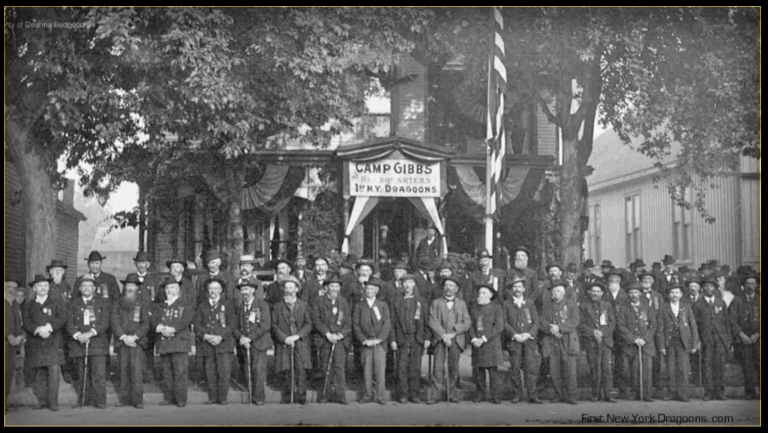
Update, July 14, 2026: this page was rebuilt from the regimental history and this site’s documented research, replacing an earlier AI-assisted draft. The curated photograph of Camp Gibbs is preserved below.
Alfred Gibbs died on December 26, 1868, at Fort Leavenworth, on duty as a major of the new 7th Cavalry, aged forty-five — his body, as the War Department’s own file shows, already broken by three wars, typhoid, and failing eyesight. The full, documented story of why history under-remembered him is told in Too Old for Glory. This page is about the part of his memory that never needed campaigning: his men’s.
Though a rigid disciplinarian, his kindness of heart soon drew the regiment to him in a strong bond of confidence and respect. That these feelings were reciprocated we never had reason to doubt. After his promotion to brigadier and brevet major-general, he always referred to the Dragoons as “my boys.”— James R. Bowen, Regimental History of the First New York Dragoons (1900), ch. II. Read the chapter on this site.
Camp Gibbs
The photograph behind this page’s title is the proof of the legacy. Thirty-two years after disbanding, the survivors of the First New York Dragoons gathered for their great reunion at Buffalo, August 23 to 28, 1897, as guests of Comrade Dr. De Villo W. Harrington — nearly four hundred of them, one from as far as England, by Bowen’s account (reproduced on this site). The name they gave their reunion encampment is written over the headquarters tent: Camp Gibbs. Their colonel had been dead twenty-nine years. The men still mustered under his name.
Where the Legacy Lives on This Site
- Too Old for Glory — the documented case for why Merritt and Custer got the fame Gibbs earned a share of: the wounds, the typhoid letter, the early death, all shown from the records.
- In Defense of Alfred Gibbs — the answer to his critics, argued from the evidence.
- The Life of Alfred Gibbs — the documentary spine of his whole career, from Sunswick to Fort Leavenworth.
- The 7th Cavalry, 1866 — his last regiment, which he helped organize at Fort Riley before Custer arrived.
- The Roll of Honor — the men he called his boys, remembered one by one.
- The regimental history, read aloud — Bowen’s book, in the editor’s voice, free on archive.org.
Sources
- Primary James R. Bowen, Regimental History of the First New York Dragoons (1900): the tribute in ch. II; the Buffalo reunion in the closing chapter.
- Primary The War Department file documented on Too Old for Glory, including the January 1866 letter recording typhoid and amaurosis, shown in scan there.
- Note: an earlier AI-drafted version of this page was retired on July 14, 2026.
Views: 95
Explore the evidence
View this article’s connected sources and media →
About this page
This article was brought over from AlfredGibbs.com. Its preserved text, media and citations remain available for comparison.